AI Agent Identity Needs Blockchain, Legal Experts Say
When Machines Start Spending Money
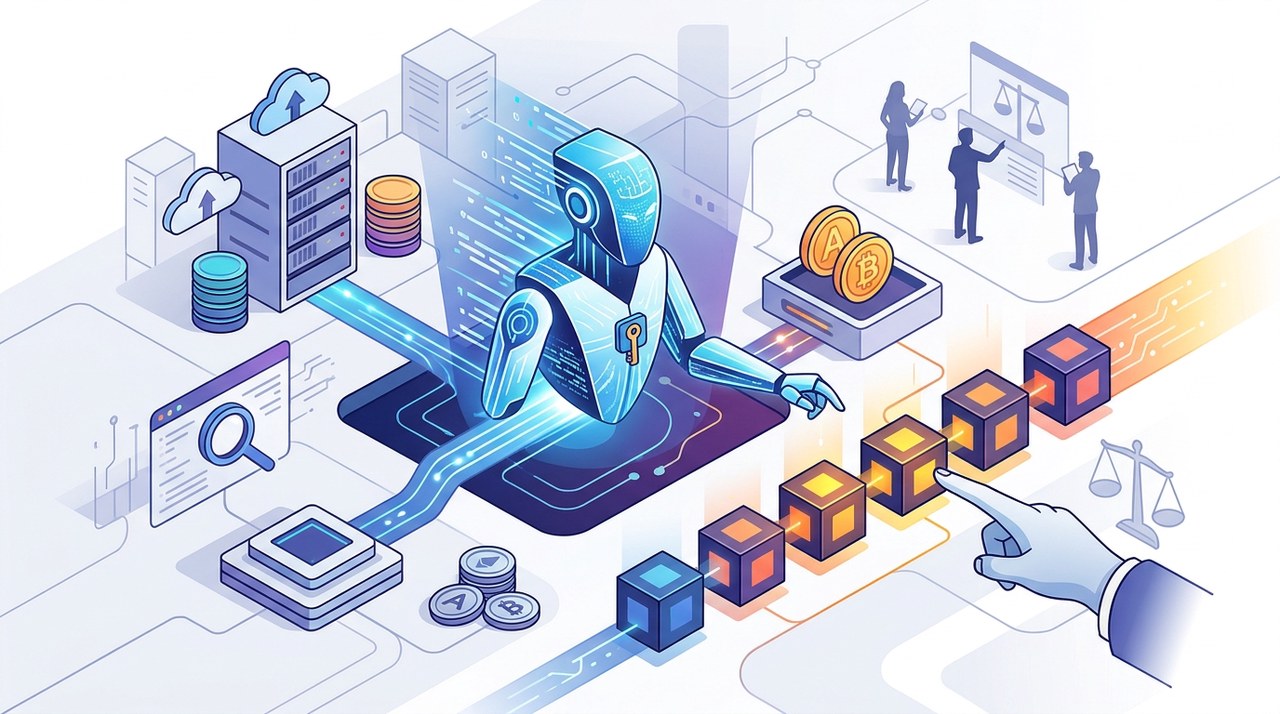
Artificial intelligence agents are no longer just answering questions. Today, they autonomously buy data, pay for cloud computing power, and purchase API searches entirely on their own.
However, existing laws still operate on the assumption that a human manually approves every financial transaction. This growing mismatch has put AI agent identity right at the center of regulatory discussions.
Members of BeInCrypto's Legal & Regulatory Council point out that blockchain technology offers a viable path to bridge this gap.
Banking Concerns and Outdated Payment Laws
The market for autonomous machine transactions is expanding fast. A report from BeInCrypto Intelligence tracked 6.4 million x402 payments over 35 days between July 23 and August 26, 2026. These transactions mostly consisted of tiny micropayments for data access and software API calls.
Despite the small size of individual payments, traditional financial institutions are treating the trend with caution. JPMorgan has already taken steps to block outside AI agents from accessing customer accounts, with CEO Jamie Dimon highlighting the risks associated with rogue software agents.
A key issue is that existing legal frameworks in the United States offer very little direction for automated transactions:
- The Electronic Fund Transfer Act still governs unauthorized transfers, but Congress enacted it back in 1978 for an era where humans authorized every single payment.
- The GENIUS Act establishes regulatory rules for stablecoin issuers, yet it says nothing about the automated software agents actually spending those stablecoins.
Because of these gaps, basic legal questions remain unanswered. For instance, if an AI agent mistakenly books the wrong flight, current rules do not clearly define who bears financial liability. This uncertainty touches on fundamental questions of both AI identity and legal responsibility.
Why AI Identity Requires Blockchain and ZK Proofs
Vyara Savova, a senior policy expert at the European Crypto Initiative, anticipates that consumers will routinely use AI agents for everyday tasks involving digital payments.
In her view, blockchain technology brings together the missing components needed for secure automated activity.
So then we have the payment rails, the identification rails, basically the trust layer, all in one, which would to a very large extent solve this.
Lawyer Anja Blaj Zajc addresses another key issue: the trade-off between user privacy and regulatory accountability. She explains that Zero-Knowledge (ZK) proofs eliminate the need to choose between the two.
A ZK proof allows one party to mathematically verify a statement is true without disclosing the sensitive information behind it.
You would have the ZK proof that proves that there's indeed a human behind that agent, that there's going to be somebody responsible for that agent.
This functionality is critical from a legal standpoint. Standard liability rules require an identifiable human or legal entity to hold accountable, whereas an anonymous wallet address provides no recourse. A ZK credential can establish a verifiable link between an agent and its owner without exposing personal data to every merchant.
European Disclosure Mandates and Industry Standard Gaps
Transparency remains a priority for lawmakers. Lord Chris Holmes, a Conservative member of the UK House of Lords who introduced a private member's bill on AI regulation, emphasizes clear disclosure.
It always needs to be clear AI was used, how it was used, for what purpose, and that consent and trust and transparency were in that mix.
European regulators have already established disclosure rules under current law. Since August 2, 2026, Article 50 of the EU AI Act obliges chatbot operators to explicitly inform users whenever they interact with an AI system.
While the broader AI Omnibus initiative moved compliance deadlines for high-risk systems to 2027 and 2028, this disclosure requirement remained active for immediate enforcement by local authorities.
The Next Step for Machine Economy Identity
While the EU AI Act mandates transparency, it does not govern payments. As of now, no legislative framework in the US or Europe specifies how a vendor can verify the human owner backing an autonomous spending agent.
Data tracking the ten most-called paid resources in the x402 catalog between August 16 and September 15, 2026, shows that machine-to-machine payments continue to grow in usage.
Until lawmakers issue clear standards for automated spending, major banking institutions are likely to keep restricting outside agents. For legal analysts, ZK-backed identity credentials remain the leading technical solution to verify accountability while protecting user privacy.
Latest blog posts



 +1
240 Million XRP Moved as Price Hits 2-Year Low of $0.89
A massive 240 million XRP transfer occurred across private wallets right as XRP touched a two-year low before rebounding.
|

 +1
Bitcoin Drops to $62K as Market Cap Slips to $2.26T
Bitcoin reached a four-month low near $62,000 as total crypto market capitalization fell 4% to $2.26 trillion, with Ether and Solana posting double-digit weekly losses.
|

Shiba Inu Exchange Reserves Risk Falling Below $300 Million
The value of Shiba Inu (SHIB) stored on crypto exchanges has dropped to $331.96 million. Continued price weakness could push reserves below $300 million for the first time in four years.
|